Introduction
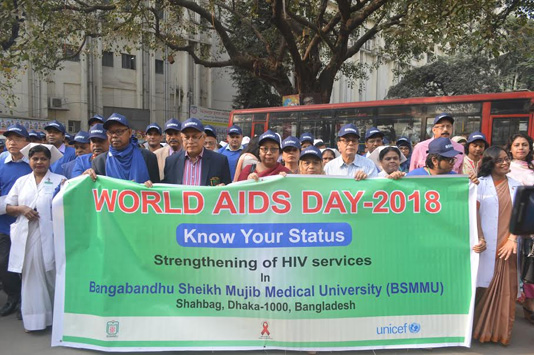
Likewise other years, this year in 2018, we have observed the World AIDS Day with the theme, “Know your status” which also marked its 30th anniversary on 1 December. Significant progress has been made in the AIDS response since 1988, and today three in four people living with HIV know their status. But we still have miles to go, as the latest UNAIDS report shows, and that includes reaching people living with HIV who do not know their status and ensuring that they are linked to quality care and prevention services.
HIV testing is essential for expanding treatment and ensuring that all people living with HIV can lead healthy and productive lives. It is also crucial to achieving the 90–90–90 [90% PLWHA will know their HIV status; 90% of HIV diagnosed people will receive ART; and 90% among those who are receiving ART will have viral suppression] targets and empowering people to make choices about HIV prevention so they can protect themselves and their loved ones.
Unfortunately, many barriers to HIV testing still remain. Stigma and discrimination still deters people from taking an HIV test. Access to confidential HIV testing is still an issue of concern. Many people still only get tested after becoming ill and symptomatic.
The good news is that there are many new ways of expanding access to HIV testing. Self-testing, community-based testing and multi-disease testing are all helping people to know their HIV status. HIV testing programs must be expanded. For this, we need political will and investment, as well as novel and innovative approaches to HIV testing that are fully leveraged and taken to scale.
About World AIDS Day
World AIDS Day originated at the 1988 World Summit of Ministers of Health on Programs for AIDS Prevention. Since then, every year United Nations agencies, governments and civil society join together to campaign around specific themes related to AIDS.
World AIDS Day, designated on 1 December every year since 1988, is an international day dedicated to raising awareness of the AIDS pandemic caused by the spread of HIV infection and mourning those who have died of the disease. Government and health officials, non-governmental organizations, and individuals around the world observe the day, often with education on AIDS prevention and control.
As of 2017, AIDS has killed between 28.9 million and 41.5 million people worldwide, and an estimated 36.7 million people are living with HIV, making it one of the most important global public health issues in recorded history. Thanks to recent improved access to antiretroviral treatment in many regions of the world, the death rate from AIDS epidemic has decreased since its peak in 2005 (1 million in 2016, compared to 1.9 million in 2005).
In its first two years, the theme of World AIDS Day focused on children and young people. While the choice of this theme was criticized at the time by some for ignoring the fact that people of all ages may become infected with HIV, the theme helped alleviate some of the stigma surrounding the disease and boost recognition of the problem as a family disease.
The Joint United Nations Program on HIV/AIDS (UNAIDS) became operational in 1996, and it took over the planning and promotion of World AIDS Day. Rather than focus on a single day, UNAIDS created the World AIDS Campaign in 1997 to focus on year-round communications, prevention and education. In 2004, the World AIDS Campaign became an independent organization.
All the World AIDS Day campaigns focus on a specific theme, chosen following consultations with UNAIDS, WHO and a large number of grassroots, national and international agencies involved in the prevention and treatment of HIV/ AIDS. As of 2008, each year›s theme is chosen by the Global Steering Committee of the World AIDS Campaign (WAC).
For each World AIDS Day from 2005 through 2010, the theme was “Stop AIDS. Keep the Promise”, designed to encourage political leaders to keep their commitment to achieve universal access to HIV/AIDS prevention, treatment, care and support by the year 2010.
As of 2012, the multi-year theme for World AIDS Day is “Getting to Zero: Zero new HIV infections. Zero deaths from AIDS-related illness. Zero discrimination.
World AIDS Day Themes
2018 Know your status
2017 My Health, My Right
2016 Hands up for #HIVprevention
2015 On the fast track to end AIDS
2014 Close the gap
2013 Zero Discrimination
2012 Together we will end AIDS
2011 Getting to Zero
2010 Universal Access and Human Rights
2009 Universal Access and Human Rights
2008 Stop AIDS. Keep the Promise – Lead – Empower – Deliver
2007 Stop AIDS. Keep the Promise – Leadership
2006 Stop AIDS. Keep the Promise – Accountability
2005 Stop AIDS. Keep the Promise
2004 Women, Girls, HIV and AIDS
2003 Stigma and Discrimination
2002 Stigma and Discrimination
2001 I care. Do you?
2000 AIDS: Men Make a Difference
1999 Listen, Learn, Live: World AIDS Campaign with Children & Young People
1998 Force for Change: World AIDS Campaign With Young People
1997 Children Living in a World with AIDS
1996 One World. One Hope
1995 Shared Rights, Shared Responsibilities
1994 AIDS and the Family
1993 Time to Act
1992 Community Commitment
1991 Sharing the Challenge
1990 Women and AIDS
1989 Youth
1988 Communication
HIV/AIDS in Bangladesh
With less than 0.1 percent of the population estimated to be HIV-positive, Bangladesh is a low HIV-prevalence country. The country faces a concentrated epidemic, and it’s very low HI prevalence rate is partly due to prevention efforts, focusing on men who have sex with men, female sex workers, and intravenous drug users. Four years before the disease’s 1989 appearance in the country, the government implemented numerous prevention efforts targeting the above high-risk populations as well as migrant workers. Although these activities have helped keep the incidence of HIV down, the number of HIV-positive individuals has increased steadily since 1994 to approximately 7,500 people in 2005 according to the International Center for Diarrheal Disease Research, Bangladesh. The 2017 data says it prevails at 13,000 people.
While HIV prevalence is very low in the general population, among Most at Risk Populations (MARPs) it rises to 0.7%. In some cases it is as high as 2.7%, for instance among casual sex workers in Hili, a small border town in northwest Bangladesh. Many of the estimated 11,000 people living with HIV are migrant workers. The 2006 National AIDS/STD program estimated that 67% of identified HIV positive cases in the country were returnee migrant workers and their spouses. This is similar to findings from other organizations. According to the International Centre for Diarrheal Disease Research, Bangladesh (ICDDR, B), 47 of 259 cases of people living with HIV during the period 2002– 2004 were identified during the migration process. Other data from 2004 (from the National AIDS/Sexually Transmitted Disease (STD) program of the Ministry of Health and Family Welfare (MoHFW)) shows that 57 of 102 newly reported HIV cases were among returning migrants.
While HIV prevalence among male homosexuals and sex workers has remained below 1 percent, unsafe practices among drug users, particularly needle sharing, have caused a sharp increase in the number of people infected. Measurements at one central surveillance point showed that between 2001 and 2005, incidence of HIV in IDUs more than doubled – from 1.4 percent to 4.9 percent, according to UNAIDS. In 2004, 9 percent of IDUs at one location in Dhaka were HIV-positive. Compounding the risk of an epidemic, a large proportion of IDUs (up to 20 percent in some regions) reported buying sex, fewer than 10 percent of whom said they consistently used a condom.
Preventive programs
HIV/AIDS prevention programs have successfully reached 71.6 percent of commercial sex workers (CSWs) in Bangladesh, according to the 2005 United Nations General Assembly Special Session (UNGASS) Country Report. However, only 39.8 percent of sex workers reported using a condom with their most recent client, and just 23.4 percent both correctly identified ways of preventing the sexual transmission of HIV and rejected major misconceptions about HIV transmission. Other factors contributing to Bangladesh’s HIV/AIDS vulnerability include cross-border interaction with high-prevalence regions in Myanmar and northeast India, low condom use among the general population, and a general lack of knowledge about HIV/AIDS and other sexually transmitted infections (STIs).
National response
Bangladesh’s HIV/AIDS prevention program started in 1985, when the Minister of Health and Family Welfare established the National AIDS and Sexually Transmitted Diseases Program under the overall policy support of the National AIDS Council (NAC), headed by the President and chaired by the Minister of Health and Family Welfare. The National AIDS/STD Program has set in place guidelines on key issues including testing, care, blood safety, sexually transmitted infections, and prevention among youth, women, migrant populations, and sex workers. In 2004, a six-year National Strategic Plan (2004–2010) was approved. The country’s HIV policies and strategies are based on other successful family planning programs in Bangladesh and include participation from schools, as well as religious and community organizations. The AIDS Initiative Organization was launched in 2007 to fund for those without proper medication to combat the virus. The National HIV and AIDS Communication Strategy (2006–2010) was also developed and launched.
Since 2000, the Government of Bangladesh has worked with the World Bank on the HIV/AIDS Prevention Project, a $26 million program designed to prevent HIV from spreading within most-at-risk populations and into the general population. The program is being integrated into the country›s Health, Nutrition and Population Program, which is supported by the government and external donors. In 2003, a national youth policy was established on reproductive health, including HIV/AIDS awareness. Since 2006, students in 21,500 secondary and upper secondary schools have been taught about HIV/AIDS issues. The educational program introduces a «life skills» curriculum, including a chapter on HIV/AIDS drafted with assistance from the United Nations Children’s Fund (UNICEF).
Bangladesh developed its first Antiretroviral Therapy (ART) treatment guidelines in 2006, with PLHIV able to buy subsidized antiretroviral drugs from specified pharmacies. Unfortunately, most HIV diagnostic facilities are provided by NGOs based in Dhaka and most rural and cross border migrants miss out on ART, HIV testing and other associated care and support services. If they seek private care, the cost is often beyond their means.
Currently, the program funded by the Global Fund is leading the national response to fight HIV and AIDS. Bangladesh had received 3 grants on HIV/AIDS from The Global Fund to fight AIDS, Tuberculosis and Malaria: Round 2 from 2004 to 2009, Round 6 from 2007 to 2012 and Rolling Continuation Channel (RCC) from 2009 to 2015. The Round 2 grant focused mainly on prevention of HIV among young people with strategies including:
- HIV/AIDS prevention messages dissemination through information campaign in mass and print media
- HIV/AIDS orientation, training and services via Life skills education, Youth Friendly Health services and accessing condom
- Integration of HIV/AIDS in school and college curriculum
- Advocacy and sensitization of religious leaders, parents and policy makers
- Generating information for policies and programs.
Some significant achievements of the HIV/AIDS program funded by the Global Fund are
- Overall HIV Prevalence remains
- HIV/AIDS information is included in text books of secondary and higher secondary level education, from grades VI to XII, in both Bangla and English
- HIV/AIDS prevention, care & support related information now mainstreamed within the training curriculum of five different Ministries
- National standards for Youth Friendly Health Services (YFHS) have been established, now practiced in public, NGO & private health service facilities countrywide
- Standard Operating Procedures (SOP) for services to PLHIV have been endorsed by the government
- Public–private partnership has been proved to be an effective model for fighting AIDS
- Over 300 people living with HIV and AIDS (PLHIV) are receiving anti-retroviral treatment (ARV) per year
- Workplace policy on Life Skills-based Education (LSE) on HIV/AIDS endorsed by Bangladesh Garments Manufacturers’ association (BGMEA)
Under the Ministry of Religious Affairs, 4 booklets on HIV/AIDS have been published for the 4 major practicing religions in the country.
Why is World Aids Day Important?
Globally, there are an estimated 36.7 million people who have the virus. Despite the virus only being identified in 1984, more than 35 million people have died of HIV or AIDS, making it one of the most destructive pandemics in history. Even though Bangladesh is a very low prevalent country but risks are at high level. We have young people at work, floating sex workers, SOGI population, truckers, etc., various risk taking behavior population in the country who knows a little about HIV/AIDS. Thus the multiplying affect could be very high. So, we need to know more about HIV and AIDS.
Today, scientific advances have been made in HIV treatment, there are laws to protect people living with HIV and we understand so much more about the condition. Despite this, each year in the Bangladesh number of people are diagnosed with HIV, people do not know the facts about how to protect themselves and others, and stigma and discrimination remain a reality for many people living with the condition.
Recent influx of Rohingya Refugees also have given a threat of increasing HIV/AIDS. The nation has found many HIV infected people crossed Myanmar border to take shelter in Cox’sbazar. They are openly moving to other areas and mixing with host community and people thereby increasing the risks of infection more.
World AIDS Day is important because it reminds the public and government that HIV has not gone away – there is still a vital need to raise money, increase awareness, fight prejudice and improve education. Bangladesh is no different in taking action. So, raise voice against the HIV infection and ‘know your status’ to keep oneself risk free and develop the habit to avoid infection.
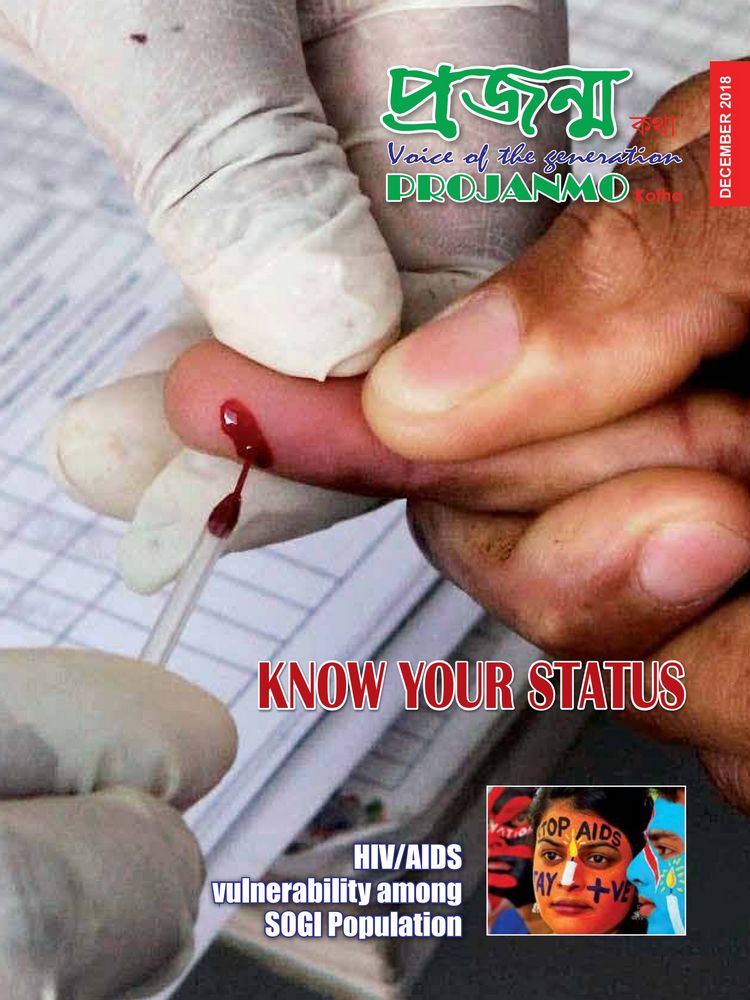
The article was written for Projomo Kotha on the year 2018 by Dr. Noor Mohammad.